
When The Factory NYC was brought on to fabricate this 65-foot hot dog sculpture for Jen Catron and Paul Outlaw, they collaborated with various vendors to ensure the project was successfully installed in the heart of Times Square. The journey from concept to realization involved thoughtful planning and problem-solving, which resulted in a magnificent final sculpture.
In this article, we’ll share behind-the-scenes processes, photos, and interviews with some key team members.
About Hot Dog in The City
Hot Dog in The City is an artwork that explores themes of consumption, capitalism, class, and contemporary culture through a supersized hot dog. The artists, Catron and Outlaw, used this installation to prompt cultural and political commentary, inviting a deeper dialogue on issues such as the immigrant experience, the meat industry’s underbelly, and American politics.
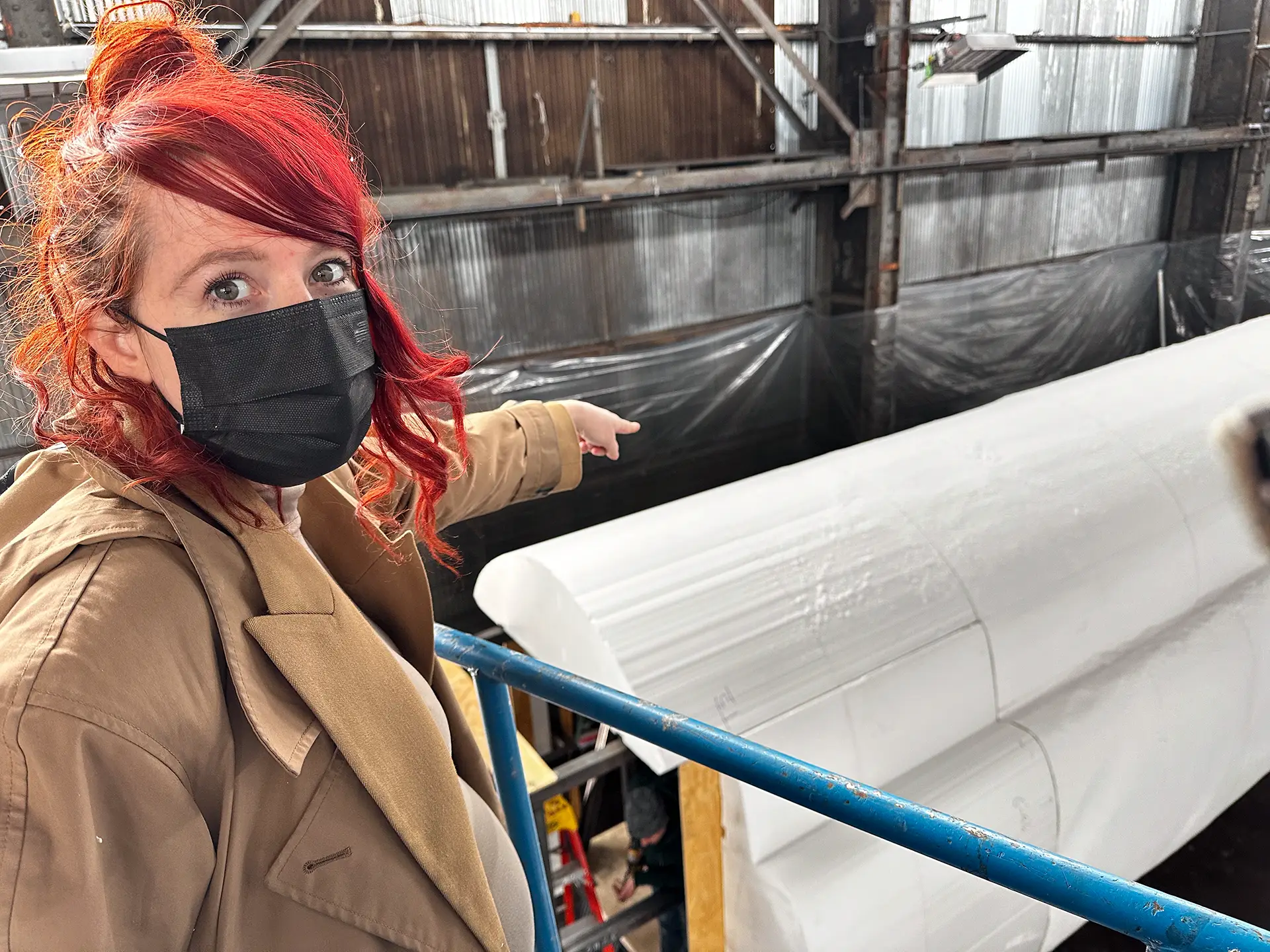
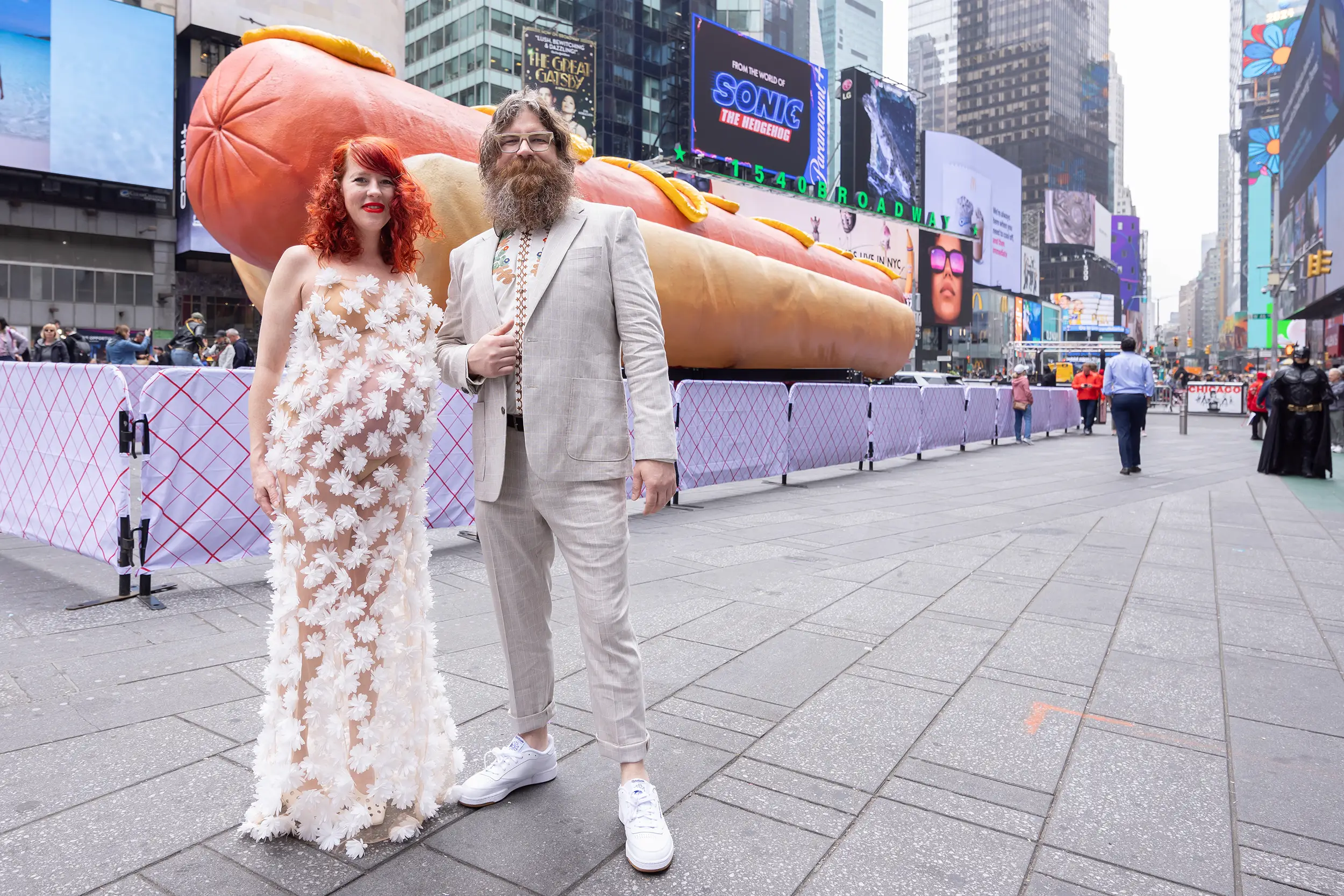
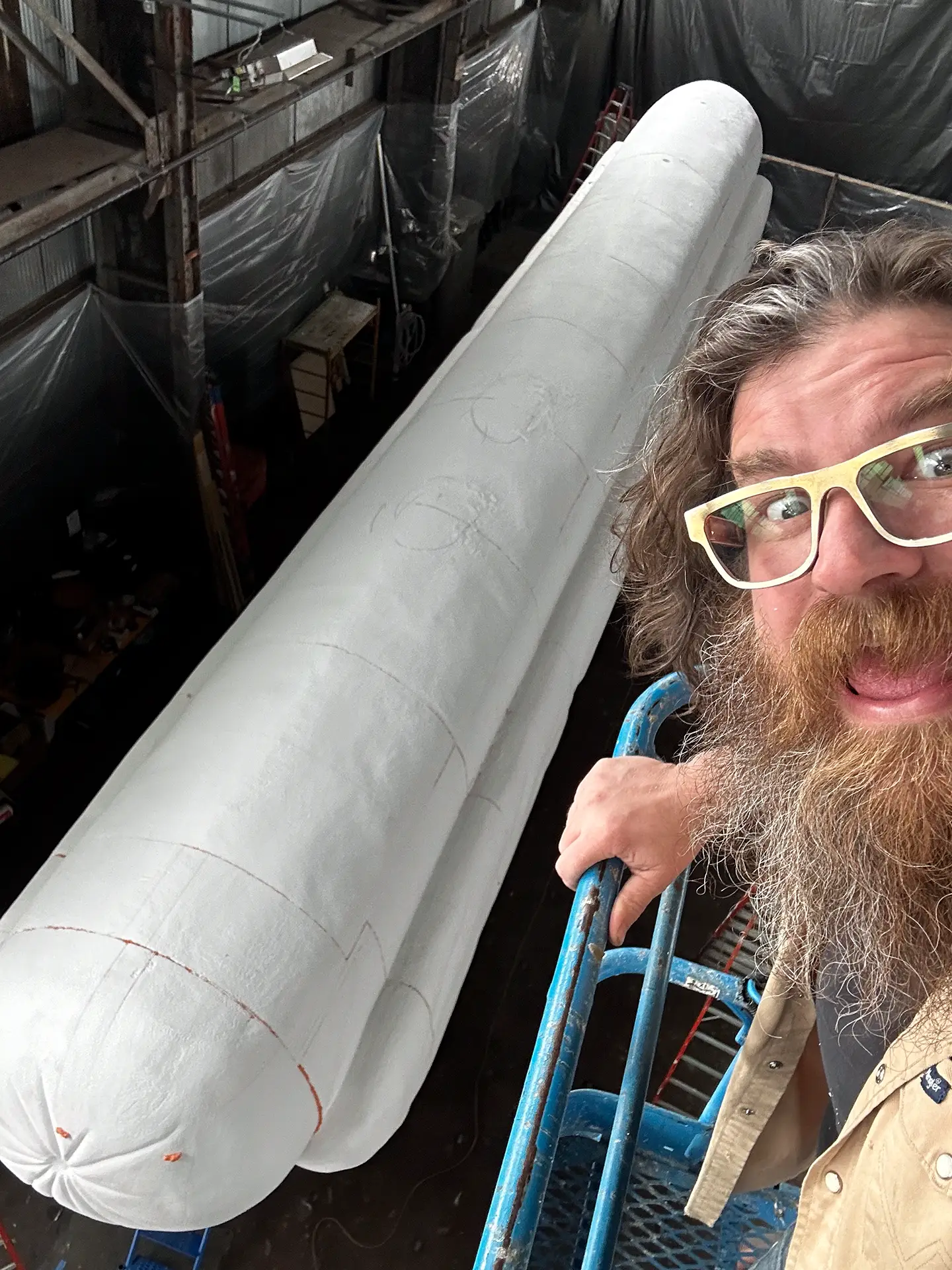
With the exceptional planning and construction of the sculpture, the artwork took about two months to create. It combined a mix of materials, processes, and techniques and required coordination with multiple vendors, including Stronghold Fine Arts for the steel frame and Themendous Scenic Studios for foam components. Artists Catron and Outlaw maintained close involvement throughout the fabrication, guiding aesthetic decisions.
Behind the Scenes: How the Hot Dog in Times Square Was Made
A significant part happened at Agger Fish, a famous warehouse, sometimes used as a filming location for movies and TV shows and a spot for artists and makers to utilize and create. Through Paul and Jen, the Factory was privileged to send some fabricators to this historic facility for about a month to construct the sculpture before it was showcased.

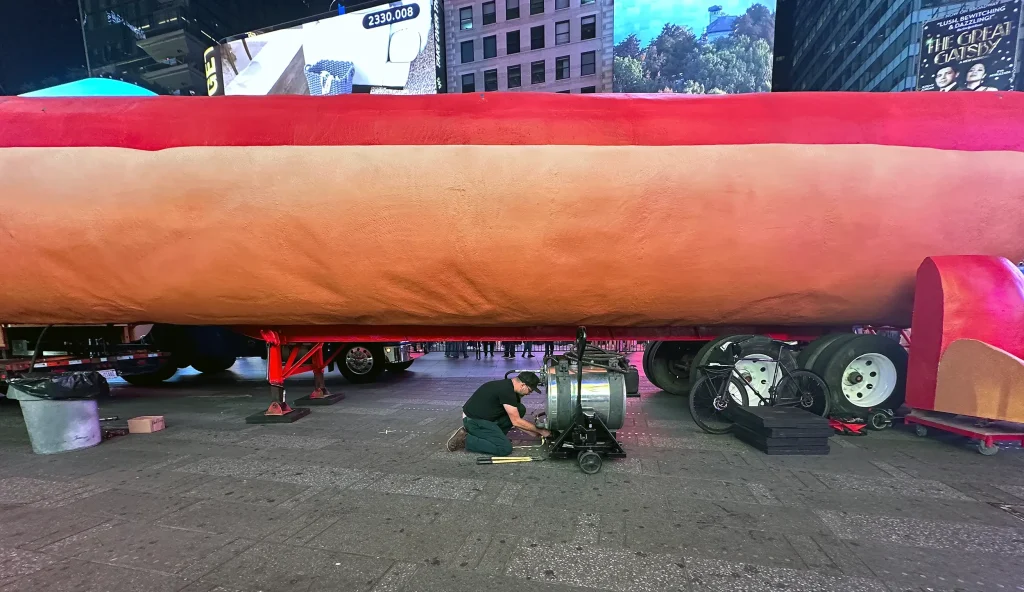
Before transporting the Dog to Agger Fish, the internal steel frame had to come together. The steel armature for the hot dog sculpture was rigged onto a semi-truck bed that had a built-in hydraulic system modified by our friends at Stronghold.
Once on site, the operator would use a manual handle to activate the motor that pressurized the system and lift up the sculpture 60 degrees into the air and have the confetti blast in all its glory at noon each day.
Because it was built onto a wheel dolly it could be discretely hidden under the chassis of the sculpture and tucked under when it was not in use.
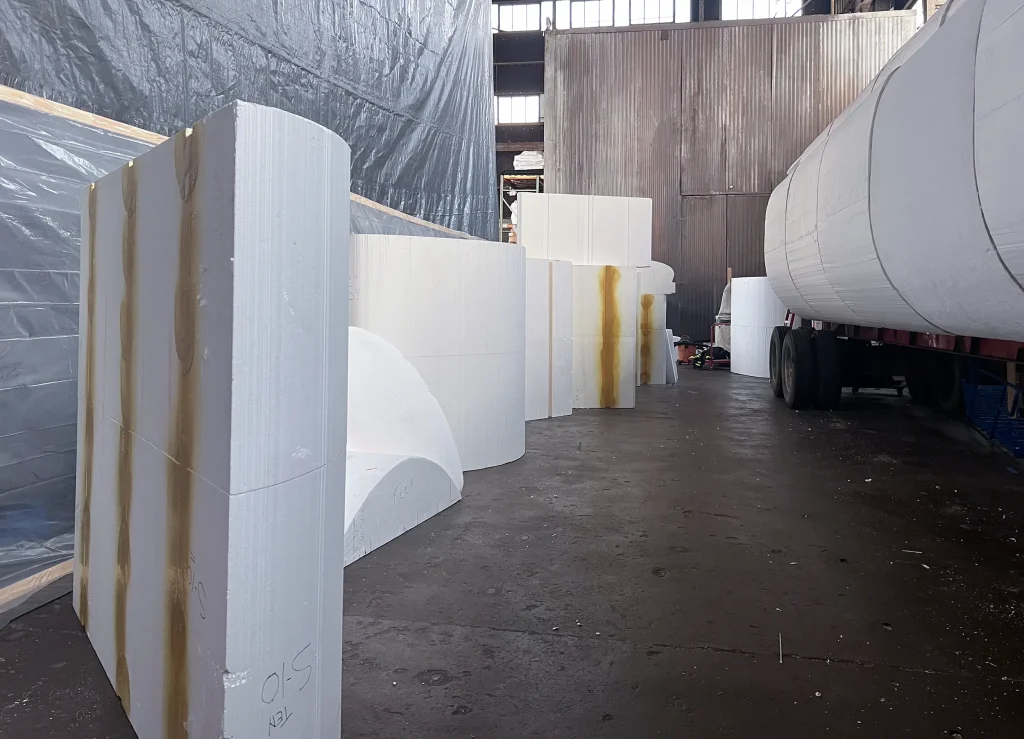
The milled foam parts needed to be organized and securely fastened to the steel in a repeatable way so that it wouldn't fail in travel or its daily functionality. After the foam was assembled and attached to the frame, the foam needed to be carved.

The foam was meticulously carved and shaved into the shape of a typical New York street hot dog. Once the sculpture was shaped to perfection, the hard coating stage began. The purpose of this yellowish substance that was sprayed onto the sculpture was to protect it from moisture and harden the surface. Once it was entirely covered, then the painting of the Dog commenced.

While interviewing Milo, the Fabrication Lead for Hot Dog in the City, we got his perspective on how he painted the entire 65-foot sculpture.
 Interview with Milo Mottola, Fabrication Lead at TFNYC
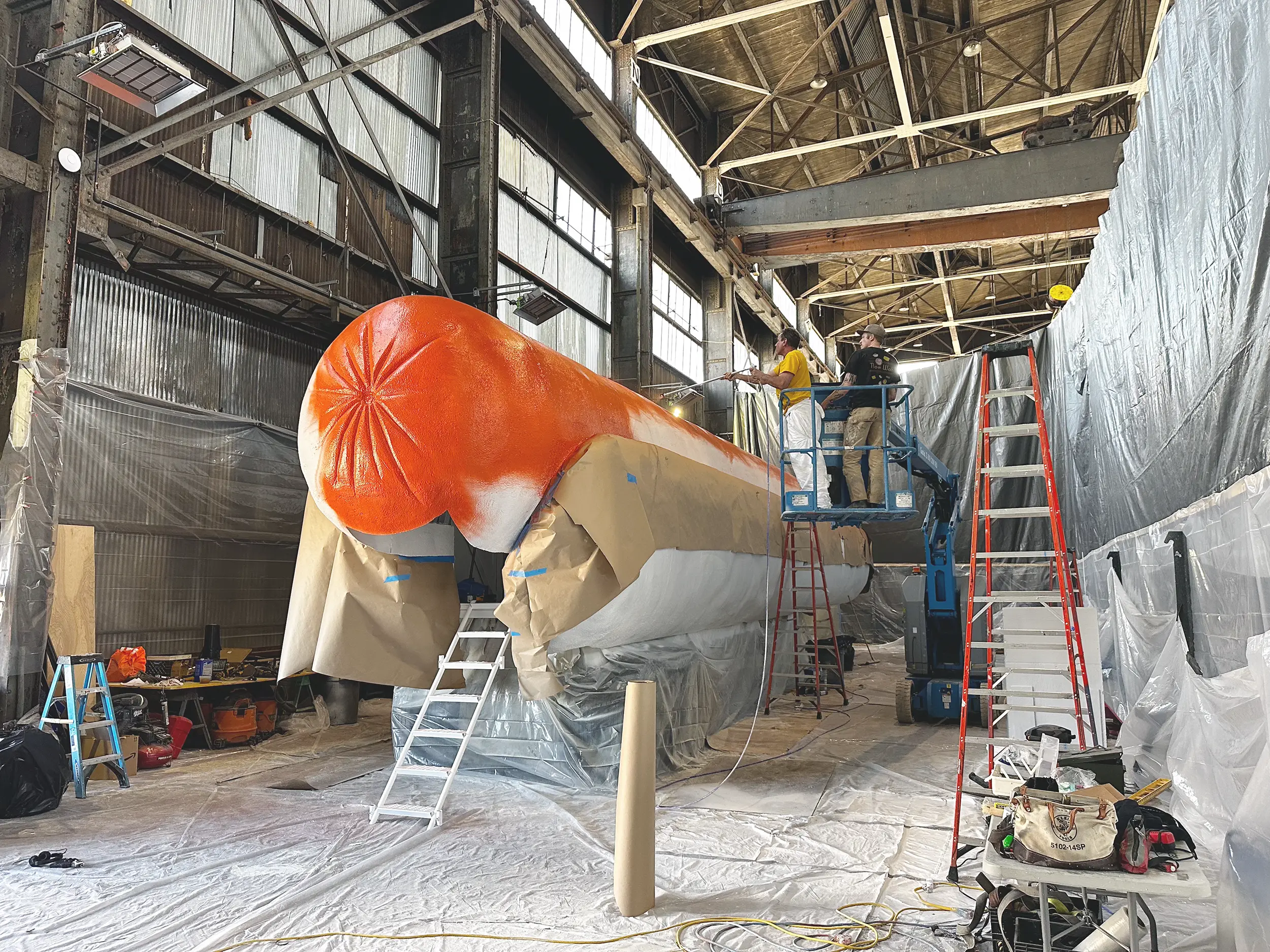
Q: Walk me through the painting process of the Hot Dog.
A: I did exactly what the artist told me to do. That was the beauty of it. I was not putting myself or what I thought into it and the finished product matched what I would have done with the lights and darks. All the color choices were spot on. The samples were amazing. It took about a month to narrow down the colors. I was part of making the samples and seeing where the artist’s mindset was. Overall, painting was fun.
Q: The hot dog was painted perfectly. How were you able to effectively apply the paint to the sculpture?
A: Well with a cherry picker. A co-worker was operating the cherry picker while I was spraying. I didn't have to put down the spray equipment and sometimes I had a long wand with a spray head, five feet away. The objective was a combination of the quantity of paint you're putting out and the distance you're at. So if I needed to, the quantity was already given, all I needed to do was get back to make that blend lighter.
Q: What was your favorite part of the entire project?
A: My favorite part was listening to the people in Times Square while we were doing the installation because it's open to sophomoric kind of comments, with innuendos and whatnot. So it was fun to listen to what New Yorkers had to say. Of course, I can't repeat any of them here hahaha.
Transporting the Hot Dog to Times Square
The transportation turned out to be quiet a process because, astonishingly enough, it is not physically possible for a 65-foot anything to travel through New York City. but the Hot Dog had to get to Times Square somehow, therefore, splitting the sculpture was essential for it to be moved.
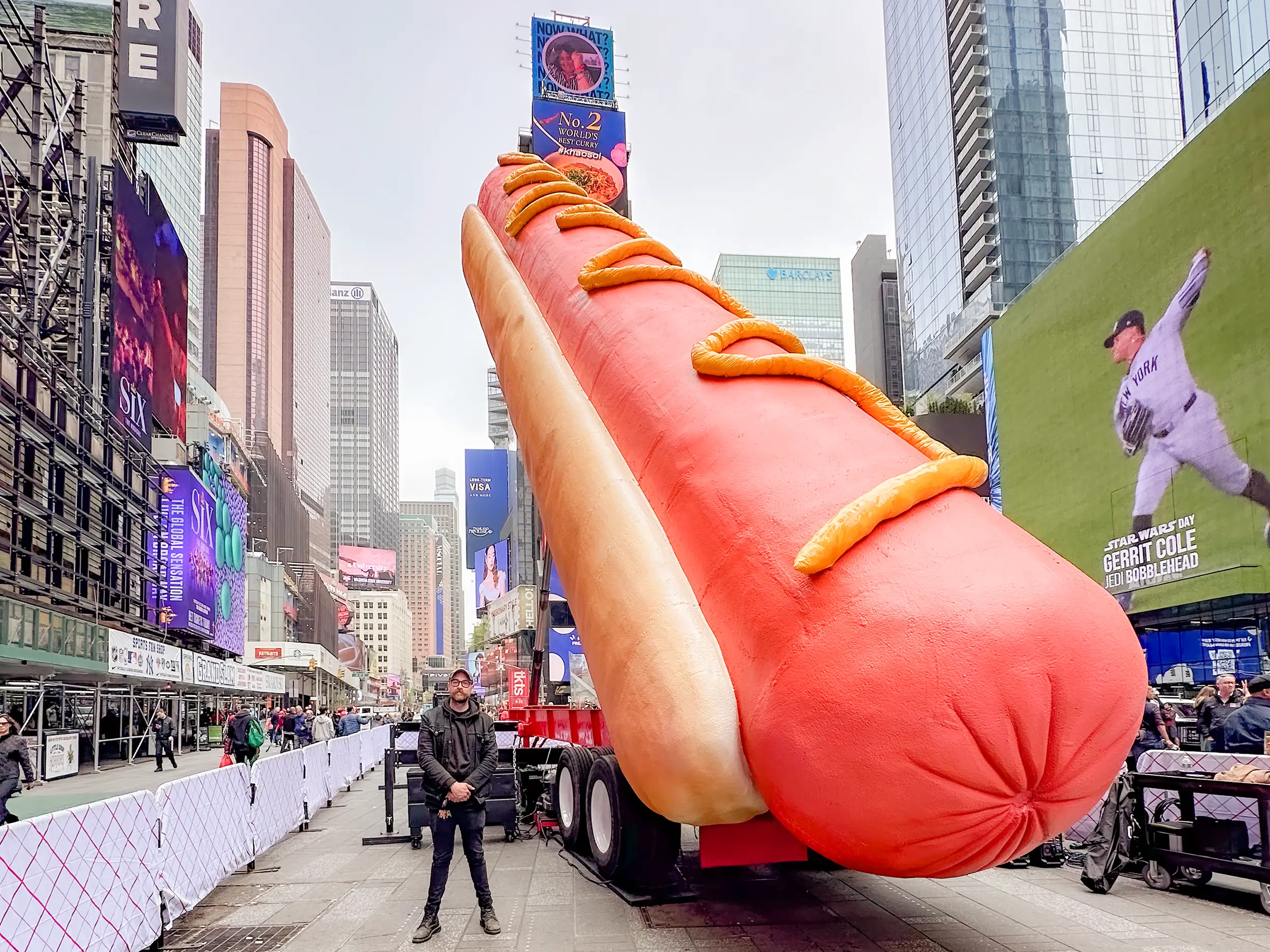
Finally, after an unusual ride from Brooklyn to Midtown, it was time for the overnight install. The two pieces of the sculpture were fastened together to be structurally sound for the daily lift-off via the hydraulic mechanisms, and the incorporated a compressed-air confetti cannon had to be ready to work without fail every day at noon.
In the early hours of the morning, the Hot Dog was ready to be unveiled, ready for it’s month-long stay in the heart of New York City and to bring joy to the masses.
 Interview with Frank Stanford, Production Director at The Factory NYC
Q: How did you ensure that confetti cannon went off every day at noon? Were there any challenges? How was it successful?
A: During the activation of the hot dog, it was a big undertaking. Times Square is a fun place to be and it was a fun thing to do. So it didn't require a lot of incentive to have a long list of people that wanted to do it.
We trained several operators involved in the project who knew how to operate the hydraulic pump. Coordinating with Times Square Alliance and other clients for several events, I corresponded with the Hot Dog almost weekly. It was a collaboration from several team members to make sure that every day for about 50 days we got to enjoy shooting confetti out of a giant Hot Dog.
Q: Being in Times Square almost daily at noon must be interesting. Were there any out-of-the-ordinary circumstances or instances that happened during that time?
A: There were several moments that were fun. Yeah, I would say from my experience, that people really enjoyed the Hot Dog confetti at noon. Regularly, when I was there to operate, people would gather around it in anticipation of it coming up. They would be asking about when it would go off. And people would chant “HOT DOG, HOT DOG, HOT DOG.” They would all cheer and clap whenever the confetti went off. It was very nice and incredible to see the kind of reach the project had.
On the other hand, some people were detractors or didn't like the Hot Dog. One lady in particular, stopped me and Jeanie from Times Square Alliance and was shaking her cane at us about some of her perceived phallic imagery represented in the Hot Dog sculpture and voicing her displeasure with that. Credit to Jeanie for giving that person one of the best artist bio summaries of the sculpture, the work, and all of the facets that brought it relevance because I don't think I was, or would be, prepared to do so.
One of our drivers, Chance told us about a guy pulling up with a bong in front of it. Lots of people dressing up as hot dogs and doing Tiktok dances as the Hot Dog went up in the air. Everybody's got some weird story.
Photography courtesy of Times Square Arts, Jen Catron, and Paul Outlaw.